
[Co-design toolkit with minors – 3/4]
The “Co-designing with and for minors” kit is the result of workshops carried out as part of developing the CNIL’s recommendations on children’s digital rights. This method made it possible to produce three case studies of interfaces adapted to young people.
Once the participants have been recruited and the preliminary research has been completed, the co-creation workshops can be prepared and conducted.
Prepare materials
Based on the information collected and analysed during the research phase, you will be able to develop the tools needed to facilitate the co-design workshops. These tools include personas, mission cards, and interaction cards to support discussions among participants.
Create personas
Analysing the information collected during the research phase (see Part 2 of the toolkit) will help you identify major trends in digital practices among the minors you work with, as well as weak signals (that is, less common behaviours or practices that nevertheless have significant implications for privacy and personal data protection).
The personas you create should be based on these findings, allowing you to develop credible characters with whom minors can identify. Create at least three profiles that reflect different digital practices.
Consider creating at least three profiles that reflect different digital practices.
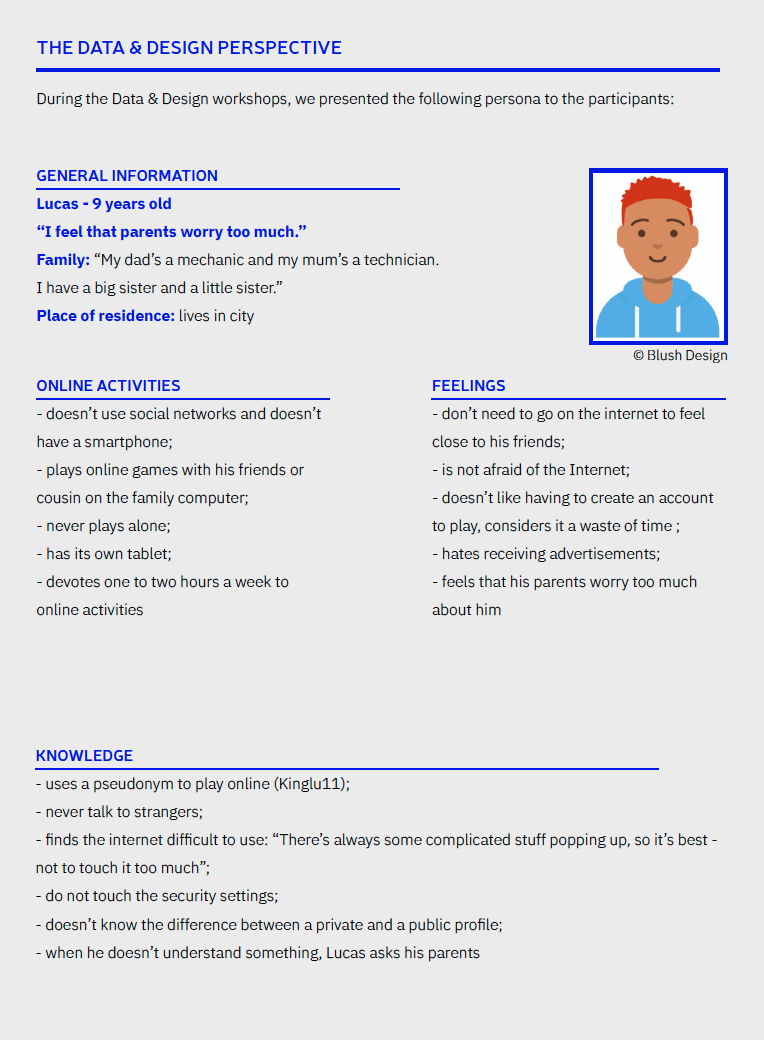
You can use the template on page 6 to create your personas, or simply use it as inspiration and adapt it as you see fit.
The template and feedback from the experience are available in the PDF version of the toolkit, pages 6 and 7.
The D&D experience: Persona example
Create mission cards
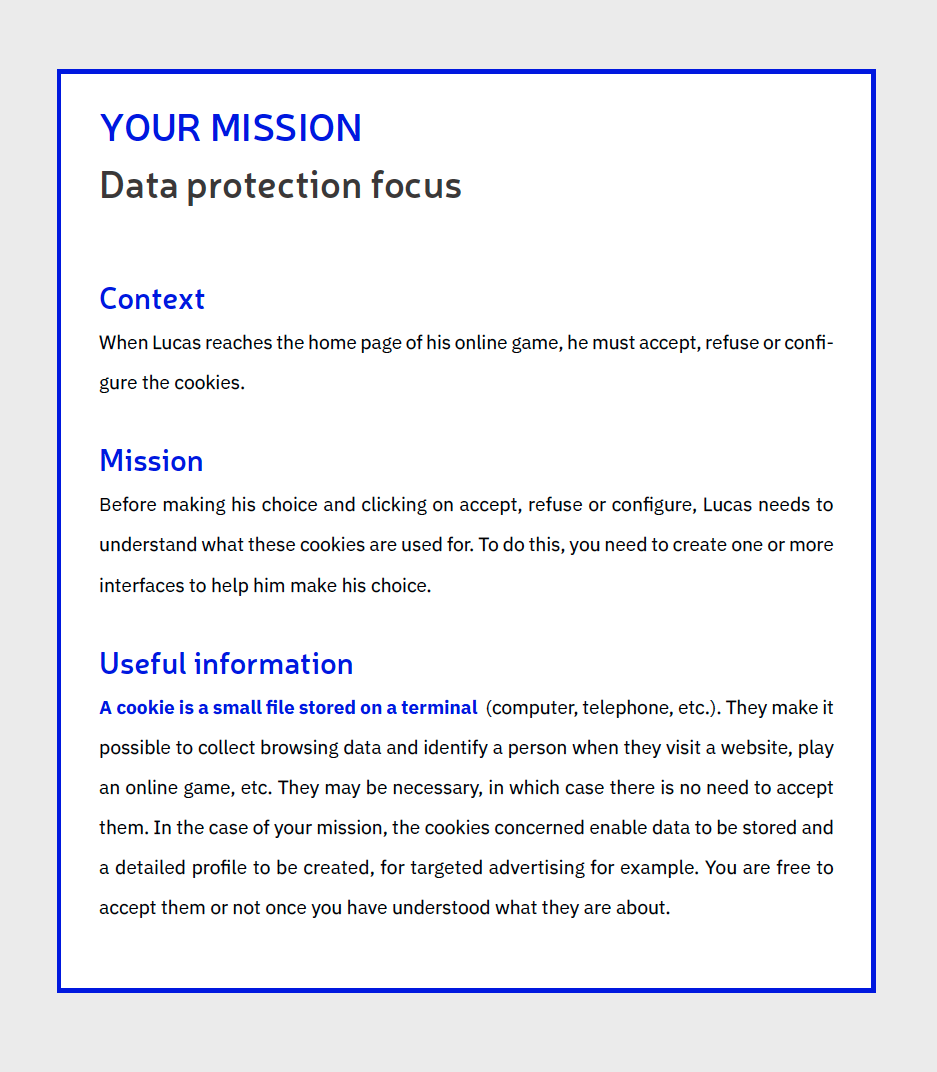
The mission cards highlight problems or situations that need to be resolved. They are based on one or more of the three pillars of data protection: information, consent and the exercise of rights. These cards should be based primarily on your context, the challenges you have identified and the information collected during the preliminary research phase. The mission cards presented here include the following information:
► Context: a short description of the situation on which participants are going to work;
► Mission: the problem participants will have to solve in relation to the situation described in the context;
► Data protection focus: the data protection aspect(s) on which participants should focus. To find out more, visit the key GDPR concepts. You can use the GDPR cards to support participants;
► Useful information: additional information that sheds light on certain elements or explains specific terms. This information is intended to help participants understand the problem and respond appropriately.
The template and feedback from the experience are available in the PDF version of the toolkit, pages 8 and 9.
THE DATA & DESIGN PERSPECTIVE: Mission card example
Define combinations of missions and personas
Each group will be asked to work on one or more combinations of persona and mission cards during the workshop. It’s best to check the possible combinations beforehand to make sure they all work. It is possible that some combinations are not coherent. These should be discarded.
There are a number of ways of putting together combinations:
► Suggest treating 1 mission card through the prism of several personas. This approach makes it possible to construct several solutions to the same problem, with each solution offering a response specific to each persona profile;
► Suggest dealing with several mission cards for 1 persona. This approach enables several problem situations to be tackled through a single prism and enables responses to be devised through a single type of use and experience;
► Propose several combinations of a mission card and a persona card. This approach multiplies the ways of understanding and resolving problematic situations through multiple user experiences;
► Draw combinations at random during the workshop. This approach requires less preparation before the workshop and is possible if all the combinations are consistent.
During the workshop, groups can work on the same or different combinations.
Interaction formats
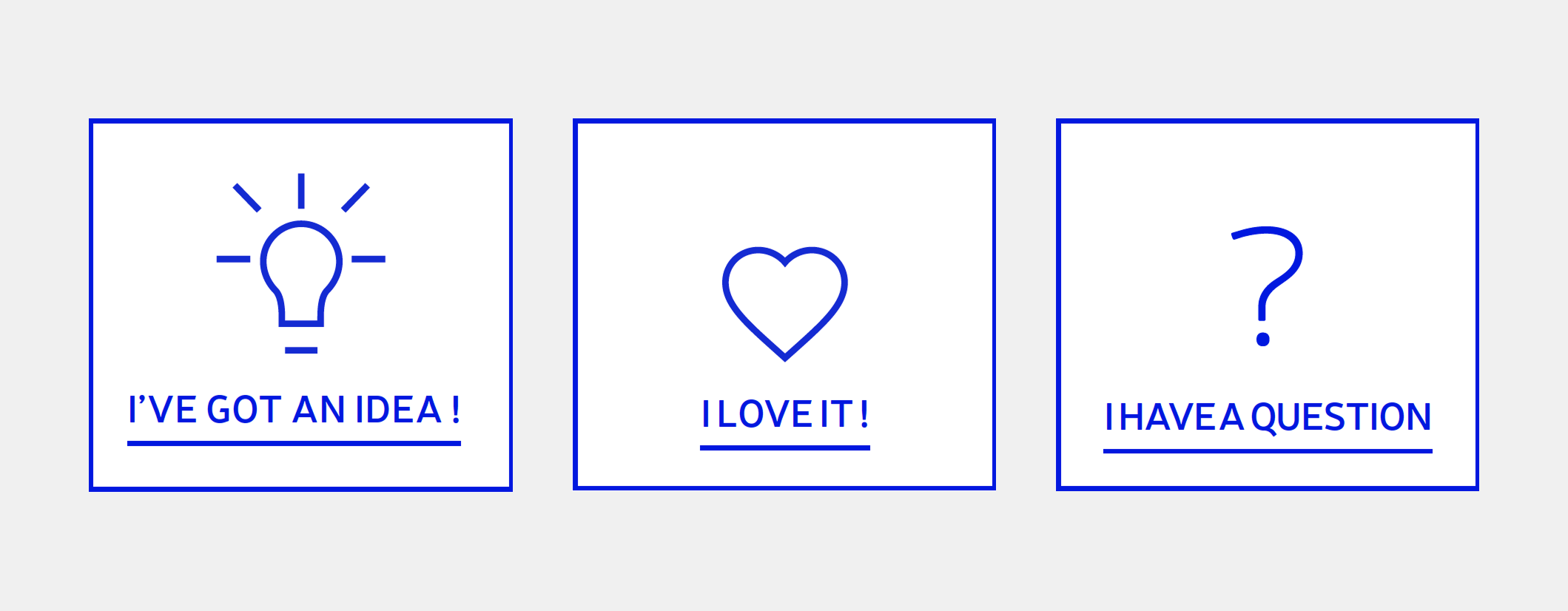
To facilitate the workshop and encourage participants to express themselves, you can provide interaction cards to help structure discussions and make them more engaging. For example, you can provide participants with cards that allow them to indicate, while listening to someone else, that they agree with what is being said, have a question or have an idea. These cards allow participants to signal that they would like to speak without interrupting the person who is currently speaking. The speaker can choose to respond to these signals whenever they wish.
Examples of interaction cards are available in the PDF version of the toolkit, page 11.
The Data & Design experience: Interaction card examples
Facilitation
During the workshop, minors will design user interfaces and user journeys that address the situations described in mission cards. Working in groups, they will develop proposals that reflect their expectations and are tailored to their digital practices.
Workshop structure
Every workshop is different, and the guidance below is provided for reference only, particularly regarding the time allocated to each activity. The pace of the workshop will depend primarily on the number and age of the participants. Younger children generally have shorter attention spans, so activities should be shorter and breaks more frequent.
The activities described below are available in the PDF version of the toolkit, pages 13 to 16.
The D&D experience:
The co-creation workshops we conducted lasted approximately 2.5 hours. They were structured as follows: ► Welcome and introduction (10 min) ► Icebreaker activity (5–10 min) ► Narrative activity (20 min) ► Break (10 min) ► Route and interface design (50–60 min) ► Discussion (40 min) ► Closing remarks (5 min)
Welcome and introduction
PRACTICAL INFORMATION
Time: 10 min
Materials: presentation slides
Objectives: remind participants of the workshop context and objectives, and introduce them to one another for the rest of the workshop.
When welcoming the participants (minors and legal guardians), it is advisable to place them directly at their group table, so that they can get to know each other and the group facilitator who will be accompanying them throughout the workshop. Groups should be made up of 4-5 people, with a minimum of 3 and a maximum of 6. If the legal guardians are present, they do not have to be in the same group as the minor they are accompanying.
This first part of the workshop provides an opportunity to introduce the session and describe the context and objectives of the workshop. It also provides an opportunity to recall a number of concepts that will be useful for the rest of the workshop, such as those relating to data protection. It is also an opportunity to create a dynamic, positive and trusting atmosphere in which minors feel comfortable expressing themselves. The facilitator takes the opportunity to answer any initial questions.
Icebreaker activity
PRACTICAL INFORMATION
Time: 5–10 min
Materials: depending on the activity
Objective: create a group dynamic.
This activity should last no more than 10 minutes and allows participants to get to know one another through a simple and fun activity. Many techniques are available and can easily be found online, so you can choose the one that best suits your needs.
The D&D experience
The icebreaker used in our workshops was an exquisite corpse exercise based on the prompt “For me, privacy is…”. Each participant took turns writing their answer, folding the sheet to hide what they had written, and passing it to the person next to them. Once each participant had written their sentence, the last participant unfolded the sheet. Each participant then read out their sentence, giving everyone an opportunity to react and discuss.
Storytelling activity
PRACTICAL INFORMATION
Time: 20 min
Materials: A3 sheets, pencils, felt-tip pens, tape or Patafix
Objective: create a group dynamic.
The storytelling activity introduces issues relating to personal data and their use by drawing an analogy with contexts that are familiar to minors. This helps connect sometimes abstract concepts with concrete situations, which is particularly important for younger children.
The D&D experience
During this activity, participants were projected into an amusement park divided into 4 universes. As they enter the park, participants are analysed by a computer which identifies their tastes and habits and decides which part of the park to send them to. It is then impossible for participants to change universe. Faced with this situation, which illustrates the practices of online profiling and associated recommendations, the participants are invited to express their views: what do they think of this situation? Do they have a problem with it? Would they like to go into other universes? What are they missing out on by not being able to go there? etc…
User journey and interface design
PRACTICAL INFORMATION
Time: 50–60 min per group
Materials: Post-it notes, paper, pencils, personas, mission cards, UI kit.
Deliverables: a user journey or interface addressing the challenge presented in the mission cards.
Objective: ensure that the challenges presented in the mission cards are addressed by minors in line with their expectations and needs.
To begin this design activity, the facilitator ensures that all participants understand the different materials. They take the time to answer any questions the minors may have and ensure that all the elements are properly understood, for example by explaining any specific terms used.
Once this has been done, the facilitator guides participants in creating a user journey and interfaces that respond to the mission card based on the selected persona. The facilitator can help minors draw or express their ideas by asking questions or rephrasing their suggestions, while taking care not to introduce their own ideas or biases. To represent the interfaces, participants can use the user interface elements provided in the UI kit.
An iterative approach is recommended during this design phase, starting by generating a wide range of ideas and gradually refining them. Depending on the group dynamics, it may be useful to begin with individual reflection, followed by a group discussion to share ideas and select those preferred by the group as a whole. The facilitator should ensure that every participant has an opportunity to express themselves and is involved in the interface design process.
Discussion
PRACTICAL INFORMATION
Time: depending on the number of groups, allow 10 to 15 min per group;
Materials: Post-it notes, pencils, reaction cards.
Deliverables: commented and revised user journeys or interfaces
Objective: review and improve the interfaces co-designed during the previous activity.
Once they have developed their solutions, each group presents the different ideas they generated during the design phase, followed by the approach they took. It is preferable for minors to lead the presentation, with the facilitator stepping in to clarify any points if needed. Other participants are encouraged to share their feedback using the interaction cards. The facilitators take note of these comments and add them to the existing interface. If you use Post-it notes, you can assign a colour to each type of suggestion or reaction. For example, use yellow for improvement suggestions and blue for points requiring attention.